
Introduction — Why Agile Needed a Reinvention Before AI Could Improve It
In 2026, software teams find themselves operating under unprecedented pressure. Release cycles are shorter, customer expectations shift rapidly, product complexity has multiplied, and engineering teams are now distributed across multiple continents and time zones. Traditional Agile ceremonies created more than two decades ago were designed for co-located teams working on predictable workloads. Today, the reality is drastically different.
A single product feature might depend on four microservices, two external APIs, a design system, and half a dozen asynchronous decision-makers scattered across five time zones. A single sprint might involve ten parallel conversations happening in Slack, ten Jira tickets moving at different speeds, and ten pull requests waiting on reviewers who are asleep in another part of the world. A human Scrum Master cannot keep up with this pace of information flow alone not because they lack skill, but because the modern engineering ecosystem generates far more signals than any one person can monitor continuously.
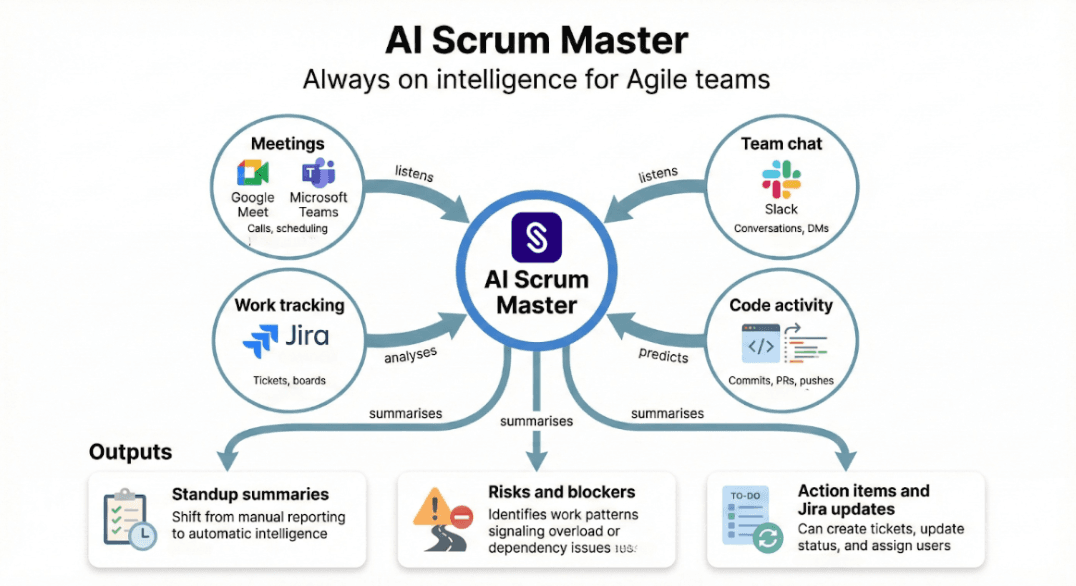
This gap is exactly where the AI Scrum Master steps in. Far more than a chatbot or automation script, an AI Scrum Master is a real-time intelligence engine embedded in an Agile team's daily workflow. Instead of waiting for developers to report status, it reads their actual work patterns. Instead of relying on memory or gut-feel to predict risks, it uses data from prior sprints. Instead of summarizing conversations by hand, it compiles accurate documentation instantly. And instead of simply "assisting," it actively reduces the cognitive and administrative load across the entire Agile lifecycle.
Tools like Scrummer AI are leading this transformation by offering a deeply contextual, predictive, and operationally aware AI Scrum Master designed specifically for modern engineering realities.
This article is the most detailed and comprehensive guide online about AI Scrum Masters—built to rank on SEO, optimized for AEO queries, fully humanized, and tailored for leadership readers who want more than shallow definitions.
What Exactly Is an AI Scrum Master? A Complete Explanation Beyond the Buzzword
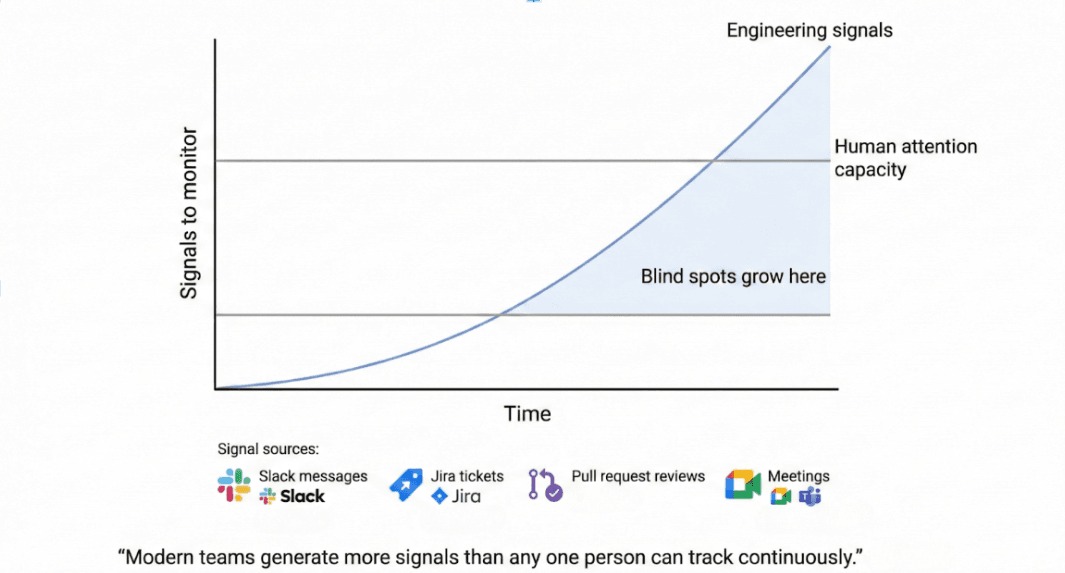
The simplest definition is that an AI Scrum Master is an intelligent system that automates, analyzes, and enhances Agile processes in real time. But that definition barely scratches the surface. To fully understand its role, consider how Agile works today: a continuous cycle of planning, alignment, execution, updates, coordination, and reflection. Each phase generates hundreds of micro-signals that indicate progress, risk, blockers, and team health. A human Scrum Master tries to make sense of these signals through meetings, status checks, and communication, but this manual effort has limitations.
An AI Scrum Master acts as a parallel analytical engine running 24/7—monitoring every Jira update, every GitHub commit, every Slack thread, every PR comment, and every timeline change. It transforms raw activity into insights that help the team maintain flow without excessive meetings or manual tracking. It highlights risks earlier, detects dependencies sooner, and surfaces invisible blockers that would have gone unnoticed until the sprint was already derailed.
Unlike generic AI tools, platforms like Scrummer AI understand Agile not as a set of rules but as a dynamic behavioral pattern. They recognize not only what changed in the sprint but also what that change means. This difference is crucial because interpretation—not information—is what makes Agile either succeed or fail. And interpretation is exactly where AI has become powerful enough to assist.
The State of Modern Agile: Why Human-Only Scrum Masters Are Struggling in 2026
Modern product delivery is a complex machine. Even in well-performing teams, three challenges frequently disrupt flow: incomplete visibility, late detection of risks, and context switching across time zones.
Let's start with visibility. Most engineering activities do not occur inside scheduled meetings; they happen in code reviews, Slack threads, comments, asynchronous updates, and behind-the-scenes workflow shifts. A human Scrum Master catches only a fraction of these signals. By contrast, an AI Scrum Master monitors them all continuously, ensuring no delay, dependency, or blocker remains invisible.
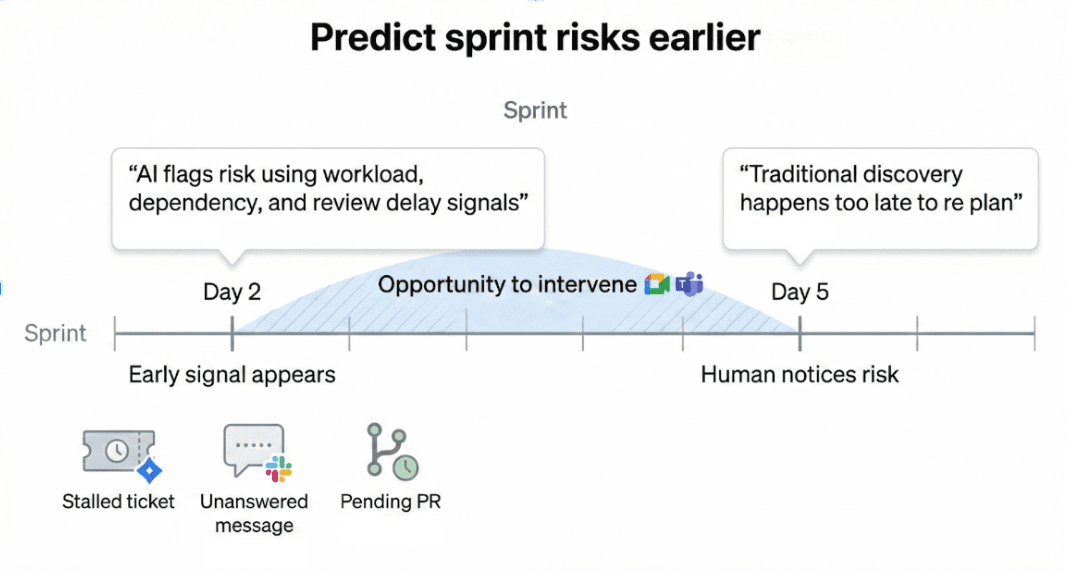
Risk detection is another weak point in traditional Agile. Teams often realize a sprint is slipping only after half the sprint has already passed. By then, it is too late to re-plan. AI changes the timing entirely by predicting risks much earlier. For example, if backend tasks are lagging behind expected velocity, AI can forecast how it will impact front-end integration days before the team realizes it organically.
The biggest modern challenge, however, is time zones. Distributed teams operate asynchronously, causing communication lags that extend delays unnecessarily. A developer in India may finish their part of a story only to wait eight hours for a US-based reviewer. The AI Scrum Master acts as a bridge—it immediately notifies the right people, summarizes the context, and prevents overnight delays from turning into multi-day blockers.
These structural issues explain why the 2026 Agile world needed an upgrade an upgrade made possible by AI.
How an AI Scrum Master Actually Works: A Deep Under-the-Hood Explanation
To understand the true value of AI in Agile, you must understand its operating mechanism.
An AI Scrum Master is built around three layers:
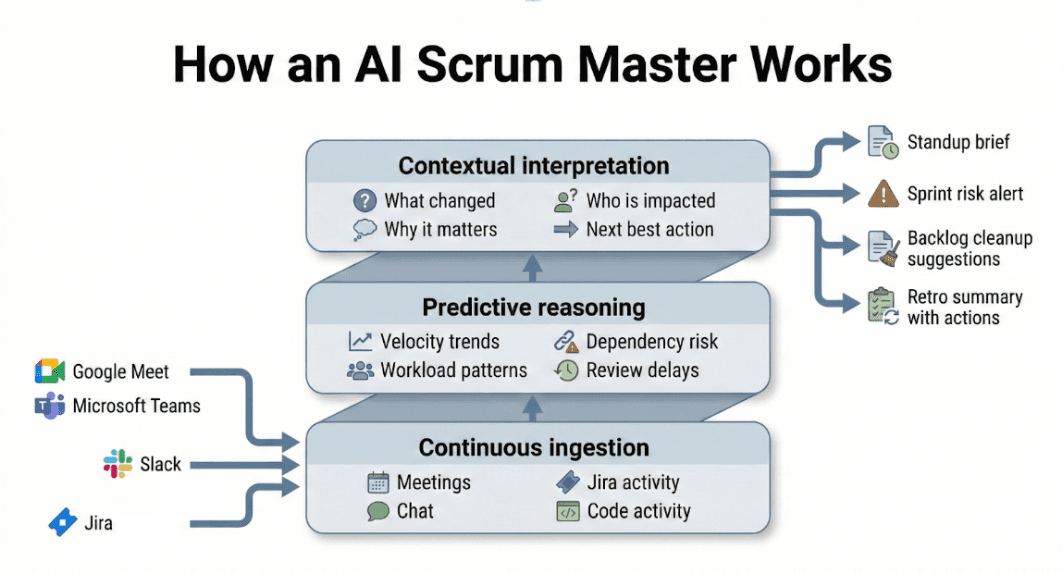
1. Continuous Data Ingestion
It integrates with Slack, Jira, GitHub, Notion, Confluence, FigJam, and other systems. Instead of waiting for manual updates, the AI reads actual activity code pushes, ticket transitions, test failures, review delays, and conversations.
2. Predictive Reasoning
Using historical sprint performance, estimation accuracy, developer workload, dependency patterns, and velocity trends, the AI predicts what is likely to fail. It doesn't just report. It warns.
3. Contextual Interpretation
This is where AI outperforms dashboards. Dashboards show data. AI interprets meaning. It knows the difference between a task that is moving slowly and a task that is blocked. It understands whether a PR is delayed because of complexity or because no one picked it up. It identifies work patterns that signal burnout, overload, or dependency issues.
This layered architecture turns the AI Scrum Master into a real strategic asset. It's not a passive observer. It's a real-time analyst.
Scrummer AI takes this a step further by humanizing its output—writing in clear, concise, leadership-friendly language unlike robotic AI tools. This makes insights accessible even to non-technical stakeholders.
Daily Standups: Why AI Makes Them Faster, More Accurate, and More Honest
One of the most powerful applications of an AI Scrum Master and one of the most misunderstood is its role in standups. Many engineers dislike standups because they are repetitive, time-consuming, and often inaccurate. Developers forget details, rush through explanations, or avoid admitting blockers.
AI changes the dynamic by shifting standups from "manual reporting" to "automatic intelligence." Instead of developers having to recall yesterday's work, the AI reads commits, PR comments, and Jira movements. It identifies inconsistencies. It flags hidden blockers. It removes filler updates and highlights what actually matters.
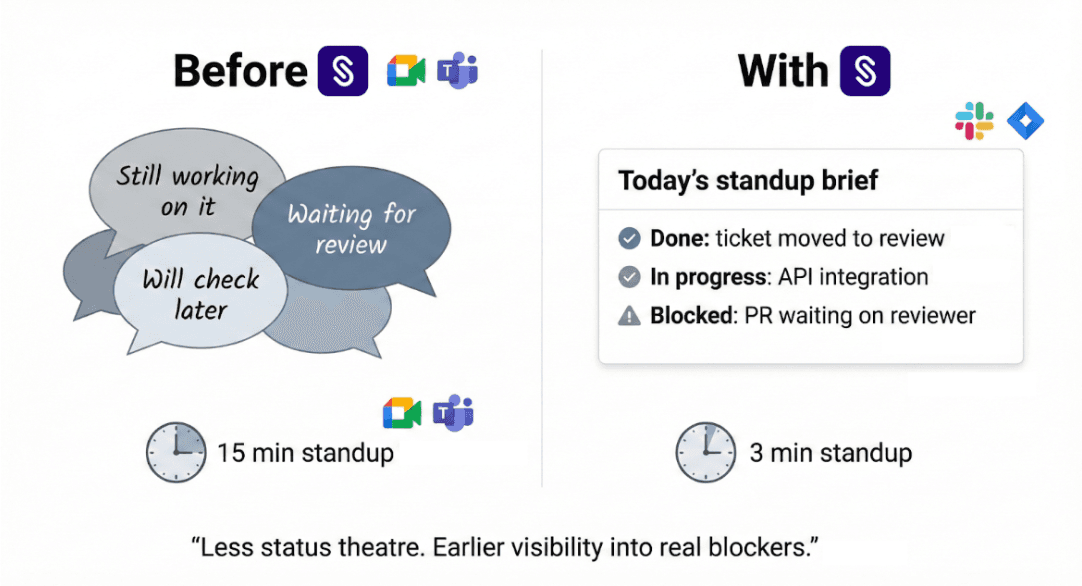
Teams then receive a clean, factual summary of progress—often before the meeting even starts. Standups shrink from 15 minutes to 3 minutes. Some teams eliminate the meeting entirely and rely solely on AI summaries. Leadership loves this because accuracy increases. Developers love it because it saves time. Scrum Masters love it because it reveals real blockers without awkward conversations.
Sprint Predictability: Where Traditional Agile Fails and AI Excels
Sprint predictability is the most demanded metric in engineering organizations today—and also the hardest to maintain. The human brain cannot track dozens of moving pieces simultaneously. AI can.
When Scrummer AI analyzes a sprint, it uses data from prior sprints, workload patterns, dependency chains, story point accuracy, team velocity, and PR turnaround time to detect emerging risks early.
For example:
If a critical task has not progressed in 48 hours and is assigned to a developer with multiple open pull requests, the AI reads this as a multi-layered signal: high workload + delayed task + unreviewed PR = potential sprint failure.
Human Scrum Masters rarely get visibility this early. AI does.
This early-warning system is the single biggest reason teams adopting AI report higher on-time sprint completion.
Backlog Refinement: How AI Removes Confusion and Brings Structure
Backlog refinement sessions often become chaotic. Too many items, too few details, and too much subjectivity. AI solves this through automated detection of unclear or inconsistent items.
Scrummer AI identifies stories missing acceptance criteria, items untouched for months, stories with inconsistent estimation patterns, and tasks that show no relation to product goals.
It then recommends cleaning, merging, removing, or rewriting them—saving hours of manual discussion. This makes refinement faster and more strategic.
Retrospectives: Turning Emotion-Heavy Discussions Into Data-Driven Improvement
Traditional retrospectives rely heavily on memory. People try to recollect what went wrong or right, but recollection is biased, incomplete, or filtered through emotions.
AI brings data.
Instead of "I think we were blocked by reviews," the AI shows that PR review time increased by 12 hours this sprint. Instead of "We underestimated tasks," the AI shows that 4 out of 9 stories exceeded their estimate by more than 30%. Instead of "Communication felt slow," the AI shows periods of delayed responses in cross-team Slack threads.
This removes guesswork and makes retros truly useful.
Scrummer AI then generates a clear retro summary—including actions and owners—instantly.
The Human Scrum Master Isn't Going Away. AI Makes Them Better.
A common misconception is that AI replaces human Scrum Masters. It does not.
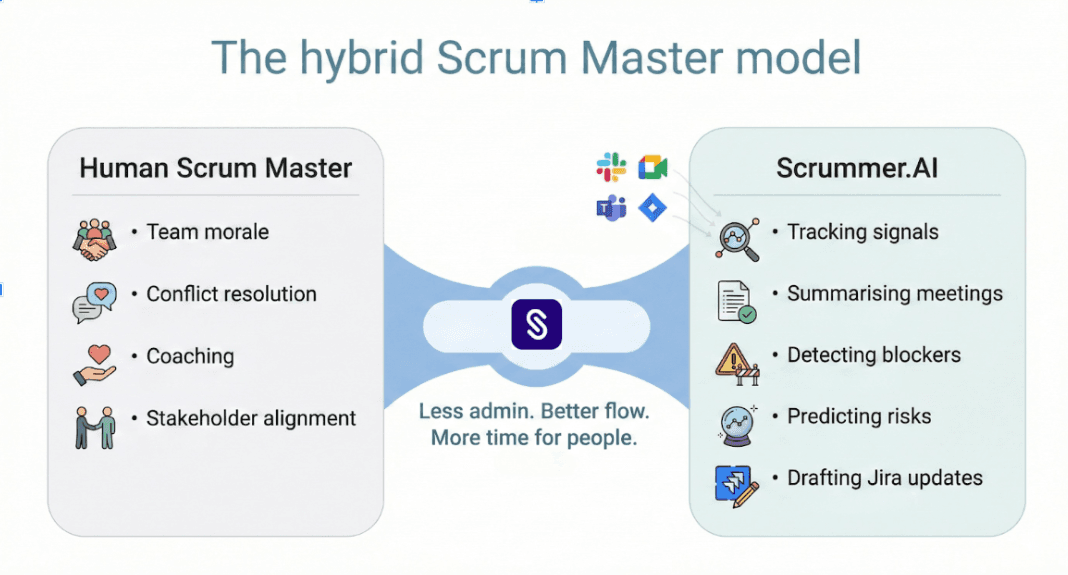
Human Scrum Masters excel at:
- Team morale - Conflict resolution - Stakeholder alignment - Motivation - Problem-solving - Communication coaching - Facilitating discussions
AI cannot do these things. What AI does is eliminate the operational burden so the human Scrum Master can focus entirely on people. This enhances their influence instead of reducing their role.
The winning model in 2026 is a hybrid model:
AI handles tracking.
Humans handle teaching.
Why Scrummer AI Leads the AI Scrum Master Category
Scrummer AI succeeds because it understands engineering teams on a deeper level:
- It reads Slack threads to understand context, not just keywords. - It reads Jira transitions not as events but as intent. - It predicts risks using long-term behavior patterns. - It reads GitHub commits to identify hidden blockers. - It writes insights in clean and human language suitable for leaders.
This makes Scrummer not just an automation tool but a strategic Agile intelligence partner.
FAQs
What does an AI Scrum Master actually do?
It automates standups, monitors sprints, detects blockers, predicts risks, refines backlogs, summarizes meetings, and enhances team alignment using real-time workflow data.
Does an AI Scrum Master replace humans?
No. It handles the operational tasks so human Scrum Masters can focus on coaching, communication, and problem-solving.
Why do teams need an AI Scrum Master?
Because modern engineering teams generate too many signals—commits, reviews, tasks, conversations—for any one person to track. AI ensures nothing slips through the cracks.
How does an AI Scrum Master improve sprint delivery?
It reduces delays, surfaces issues early, and provides real-time clarity across time zones, improving predictability.