
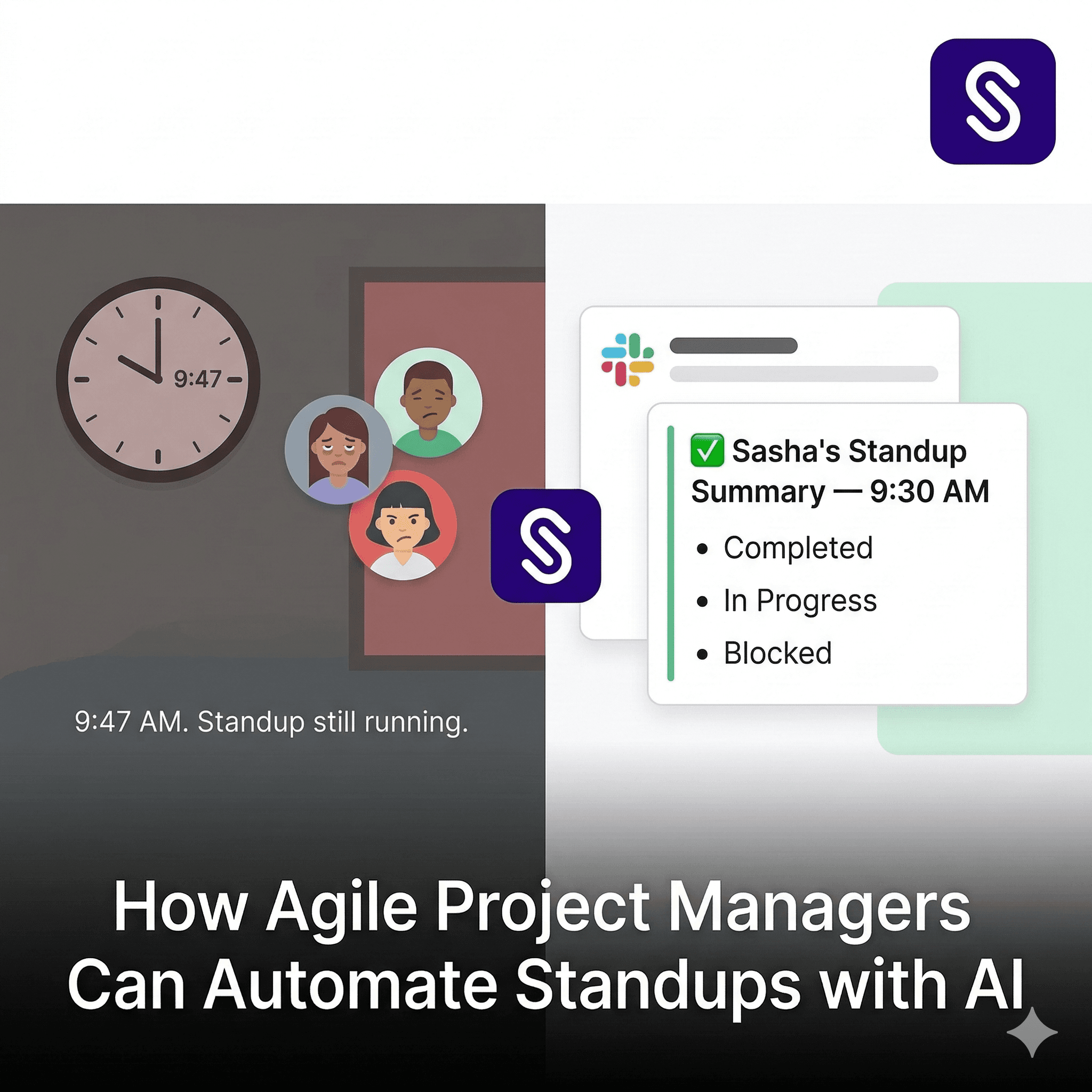
How AI standup tools like Scrummer are changing the way agile project managers run their sprints.
TL;DR
- 15-min standups cost $80,000/year for 5-person teams (w/ context switching), per meeting.cash & meetingtoll analyses — a figure echoed across engineering workflow calculators - 67% of engineering teams say meetings actively prevent task completion - AI tools like Scrummer can cut blocker resolution time from 30 hours to ~15 minutes - Agile project managers can automate standups, task updates, Jira tickets, and sprint digests — without losing the collaborative spirit of Scrum - The shift isn't about removing humans from the loop — it's about removing humans from the busywork.
Picture this: It's 9:47 AM. Your team's daily standup should have ended at 9:30, but someone is still explaining why a ticket hasn't moved. Again. Meanwhile, three engineers are silently tabbing through their IDEs, waiting to get back to actual work. And you — the agile project manager — are doing mental gymnastics trying to remember whether that blocker from Tuesday ever got resolved.
Sound familiar?
Here's the uncomfortable truth: standups are costing you more than you think — and not just in dollars. They're costing your team focus, flow, and morale. But the solution isn't to kill the standup. It's to make it smarter.
Enter the AI standup revolution, where tools like Scrummer handle daily check-ins automatically, Jira tickets update themselves, and sprint summaries land in your inbox before you've had your morning coffee.
The Hidden Cost of Manual Standups
Before we talk solutions, let's talk about the scale of the problem — because it's bigger than most agile project managers realize.
A 15-minute daily standup with 5 engineers costs $78,000–$81,000 per year when you factor in 15–20 minutes of context-switching overhead per person, according to meeting.cash analysis of tracked meetings. Zoom out to a company with four engineering teams, and you're looking at over $300,000 annually just in standup time. Even more striking: meetingtoll.com finds companies lose $50k–$150k per team from standups that routinely overrun.
The black hole of Slack decisions →
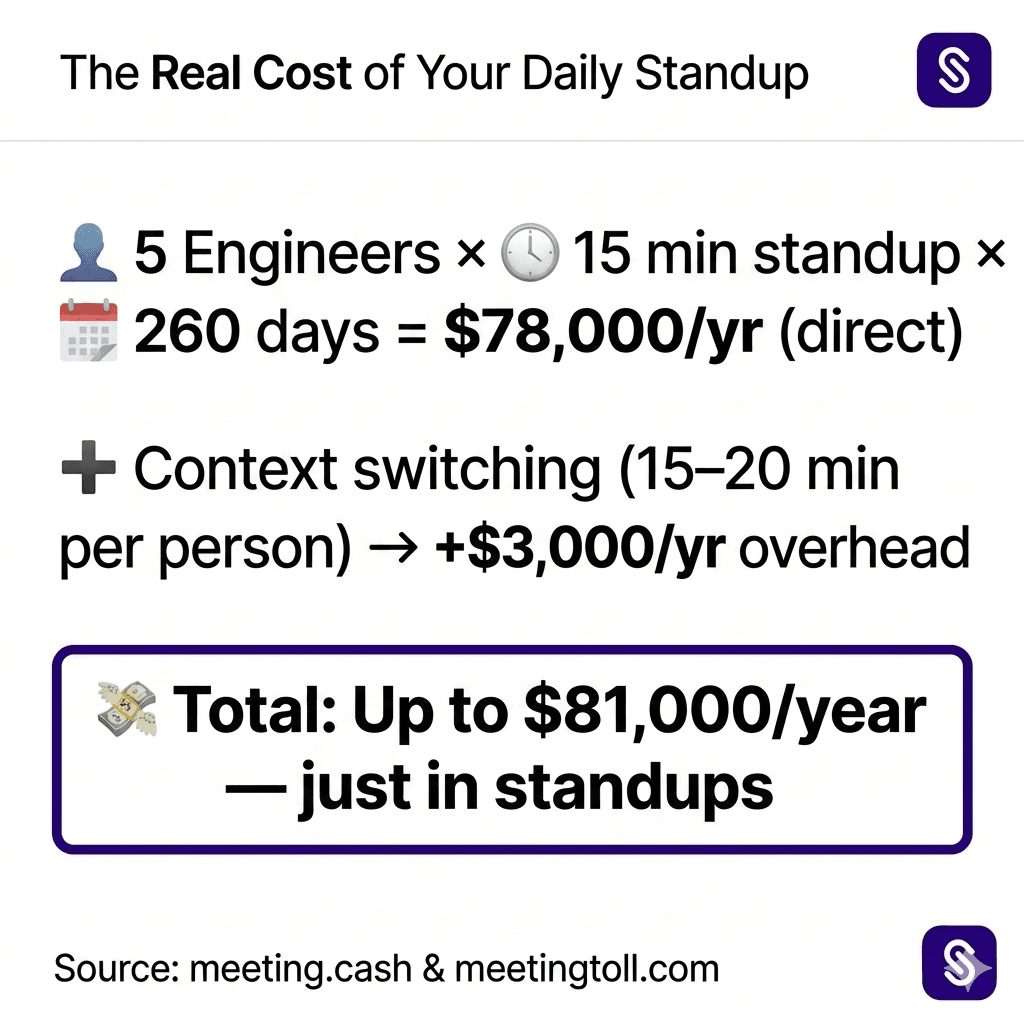
A 15-minute daily standup costs up to $81,000/year for a 5-person team when context switching is included. Source: meeting.cash & meetingtoll.com
And the cost isn't purely financial. According to Scrummer AI's own research, 67% of engineering teams say meetings prevent them from completing tasks. Teams lose an estimated 30% of execution context between standup and sprint completion — decisions evaporate into Slack threads, DMs, and half-updated Jira tickets.
⚠️ The problem isn't the standup itself. The problem is what happens after — or more accurately, what doesn't happen. Blockers sit unresolved. Action items get forgotten. The agile project manager becomes a human router, chasing updates instead of driving outcomes.
AI Standups, Task Automation, and Sprint Digests for Agile PMs
The phrase "AI automation" gets thrown around a lot in the agile space. So let's get specific about what it actually means for an agile project manager in 2026.
AI-driven automation in agile workflows covers three major buckets:
1. Automated Daily Standups (Async or AI-Facilitated)
Instead of synchronous check-ins where 70% of the team is a passive audience, an AI standup tool prompts each team member individually — at their configured time and timezone — to report what's done, what's in progress, and what's blocked. The AI collects these responses and surfaces a structured summary to the whole team and the PM. No meeting required.
2. Intelligent Task & Jira Updates
An AI scrum assistant can create Jira tickets, update statuses, assign users, and add comments — all from a natural language chat in Slack or Teams. Instead of switching contexts to open Jira after every conversation, your team can say "create a bug ticket for the login API issue" and it's done.
3. Sprint & Project Digests
Rather than manually compiling sprint progress reports, AI tools generate Kanban and sprint digests automatically, sent to the right people at the right frequency — daily, weekly, or custom.
📊 KEY INSIGHT — AI-enabled organizations outperform peers by 27% in project success rates, citing better forecasting and faster decision-making, according to PMI's Pulse of the Profession. And over 68% of Project Management Offices have already integrated at least one AI tool for automation or risk analysis.
Meet Sasha: How Scrummer Brings This to Life
Scrummer AI is built specifically for the agile project manager who's tired of playing human Jira dashboard. Its AI agent, Sasha, lives inside Slack and Microsoft Teams — the tools your team already uses — and operates across the full lifecycle of a sprint.
Here's what the workflow looks like in practice:
Before the Meeting
Scrummer syncs with your Google Calendar or Microsoft Outlook, identifies the meeting type (standup, retro, brainstorming), and prepares Sasha to join. Sasha works natively across Google Meet and Microsoft Teams calls — no extra tools or plugins needed. No configuration required for recurring meetings either — settings carry over automatically.
During the Meeting
Sasha joins your call and captures context across all attendees. After the call, it processes the meeting transcript to automatically detect blocker signals — including phrases like "blocked," "stuck," "waiting on," or "need a decision."
When a blocker is identified, Sasha auto-posts a follow-up directly in your Slack or Teams channel so nothing falls through the cracks. You can also ask Sasha mid-meeting to create a Jira ticket, update a status, or assign a task — all without leaving the call.
Learn how blocker detection works →
After the Meeting
This is where the magic really happens. Sasha delivers:
- Automatic meeting summaries to all attendees via email - Slack channel posts with threaded summaries and inline quick-actions like "Create Ticket" or "Remind Later" - Retro summaries sent to the dedicated retro channel when meeting type is set accordingly - Weekly meeting digests for async catch-up
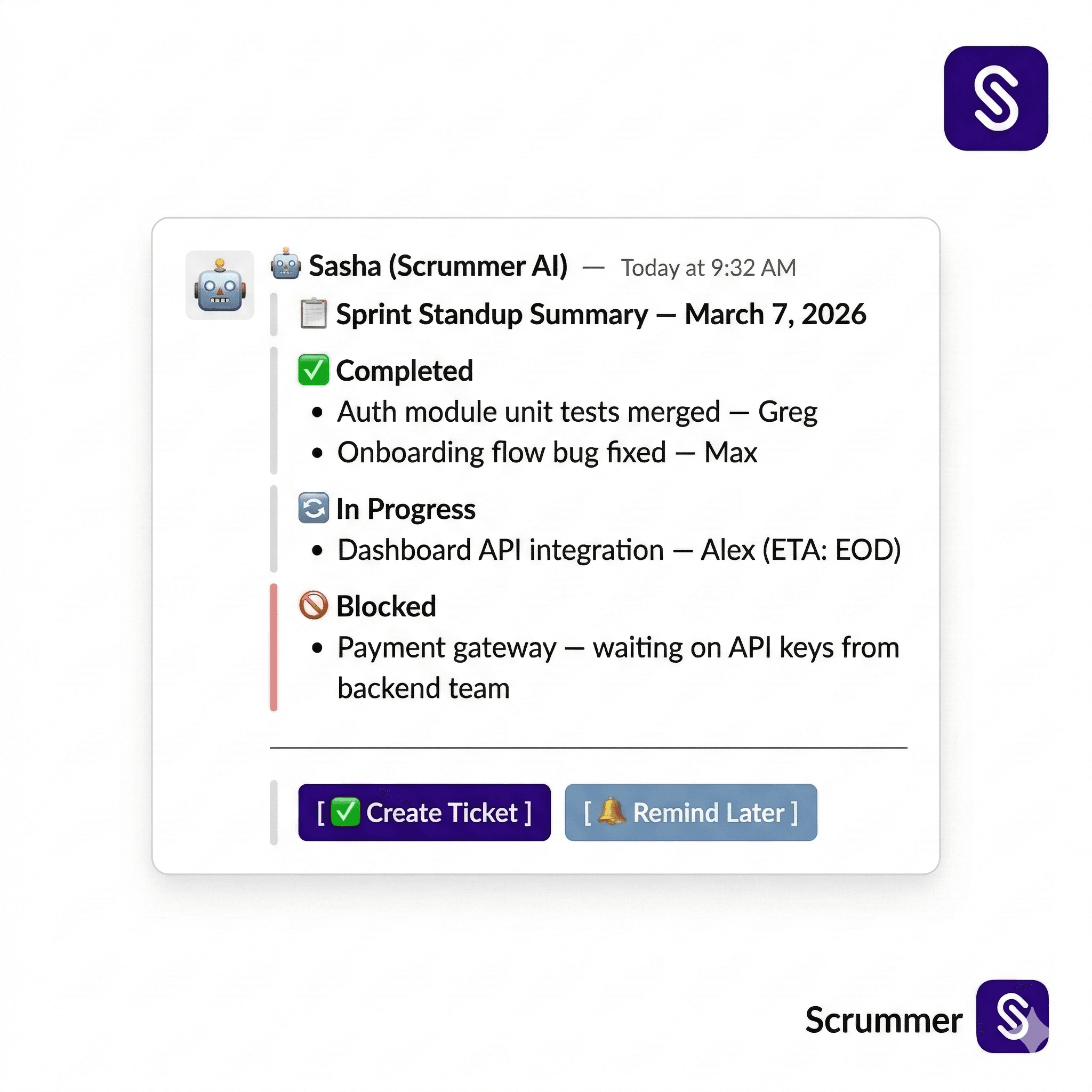
Scrummer's AI standup summary delivered in Slack — with one-click Jira ticket creation and blocker follow-ups built in.
⏱️ BLOCKER RESOLUTION — Before Scrummer, blockers sat unresolved for an average of 30 hours. With automated blocker detection and direct DM threading between the right teammates, resolution drops to approximately 15 minutes.
Why AI Standups Won't Kill Team Pulse (They'll Save It)
Async AI standups spark fear — but Scrummer proves they amplify alignment.
One of the biggest fears agile project managers have about async standups is that they'll lose the pulse of the team. Will people actually fill in their updates? Will blockers still surface in time?
Scrummer's daily check-in feature addresses this directly. The agent proactively prompts each team member in Slack or Teams at a configured time, asking for:
- ✅ What they completed - 🔄 What's in progress - 🚫 What's blocking them
Why the 30-minute standup is dead →
If a blocker is reported, Scrummer doesn't just log it — it automatically creates a DM thread between the blocked team member and the relevant person who can unblock them. The agile project manager is looped in, but doesn't have to manually facilitate the introduction.
Each team member can also have individual timezone and check-in time settings, making this powerful for distributed and async-first agile teams.
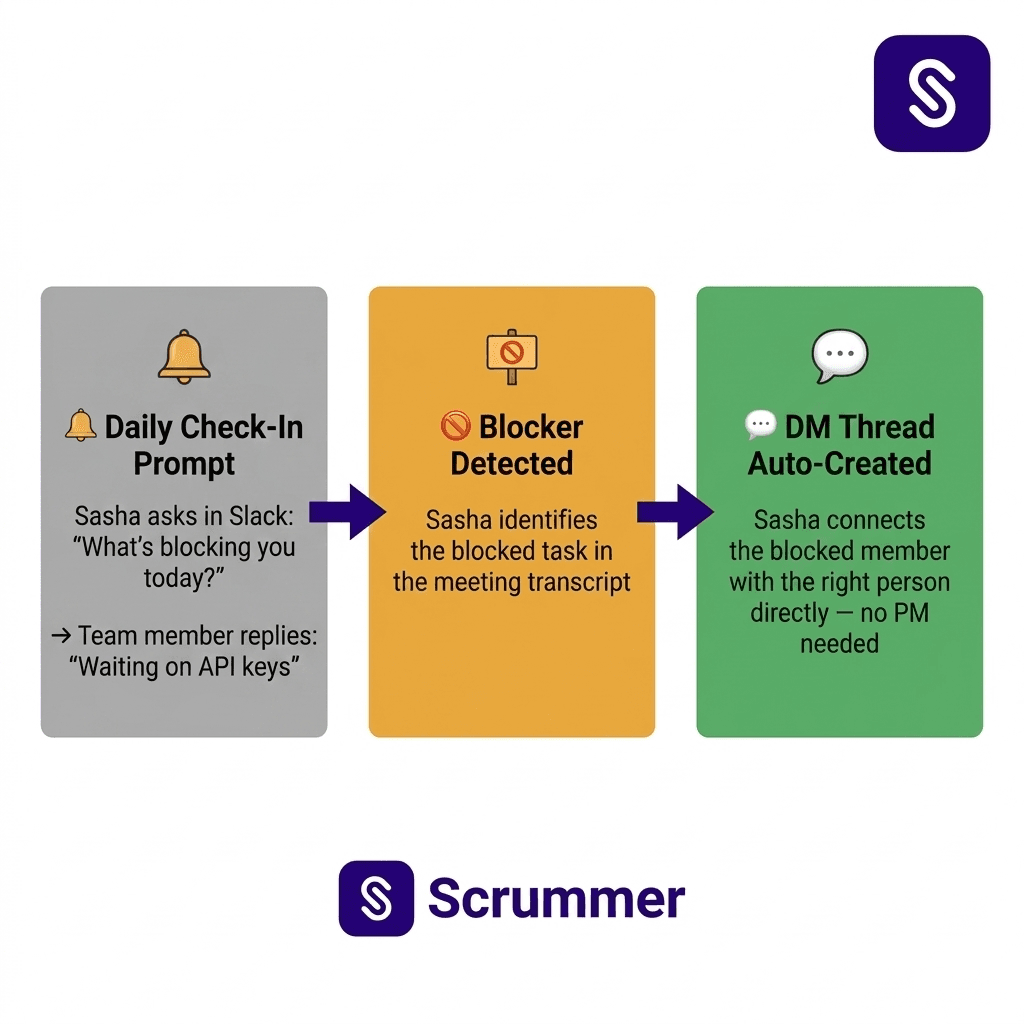
How Scrummer's AI standup detects blockers and auto-creates DM threads — cutting resolution time from 30 hours to 15 minutes.
|Traditional Standup|AI Standup - Scrummer.ai| |---|---| |Fixed daily time, everyone must attend|Async prompts at each person's configured time| |Blockers raised verbally, easily forgotten|Blockers auto-detected, DM thread auto-created| |PM must follow up manually|Sasha follows up automatically| |Context lost after meeting|Summaries stored, queryable in Slack| |Jira updated later (or never)|Jira updated via chat in real-time|
Research shows that 47% of daily standups could be run async without losing team alignment — and teams that make the switch report 15–20% higher deep work time.
Sprint Automation: From Planning to Digest
The agile project manager's job doesn't end at standup. Sprint planning, backlog grooming, retrospectives, and stakeholder reporting all eat into the week. Scrummer tackles sprint automation end-to-end.
Jira via Chat
Rather than context-switching to Jira for every small update, your team can manage tickets conversationally. Ask Sasha in Slack: "What tickets are still in progress for this sprint?" or "Move the auth bug to Done and assign it to Priya" — and it happens instantly. This natural query capability eliminates one of the biggest friction points in agile workflows: keeping the board up to date.
Sprint & Kanban Digest Emails
For each connected Jira project or board, Scrummer generates automated digest reports. These can be:
- Daily for fast-moving sprints - Weekly for broader stakeholder updates - Custom frequency for teams with specific reporting needs
Additional recipients can be added (think: engineering managers, product leads, or clients), and Scrummer handles distribution automatically.
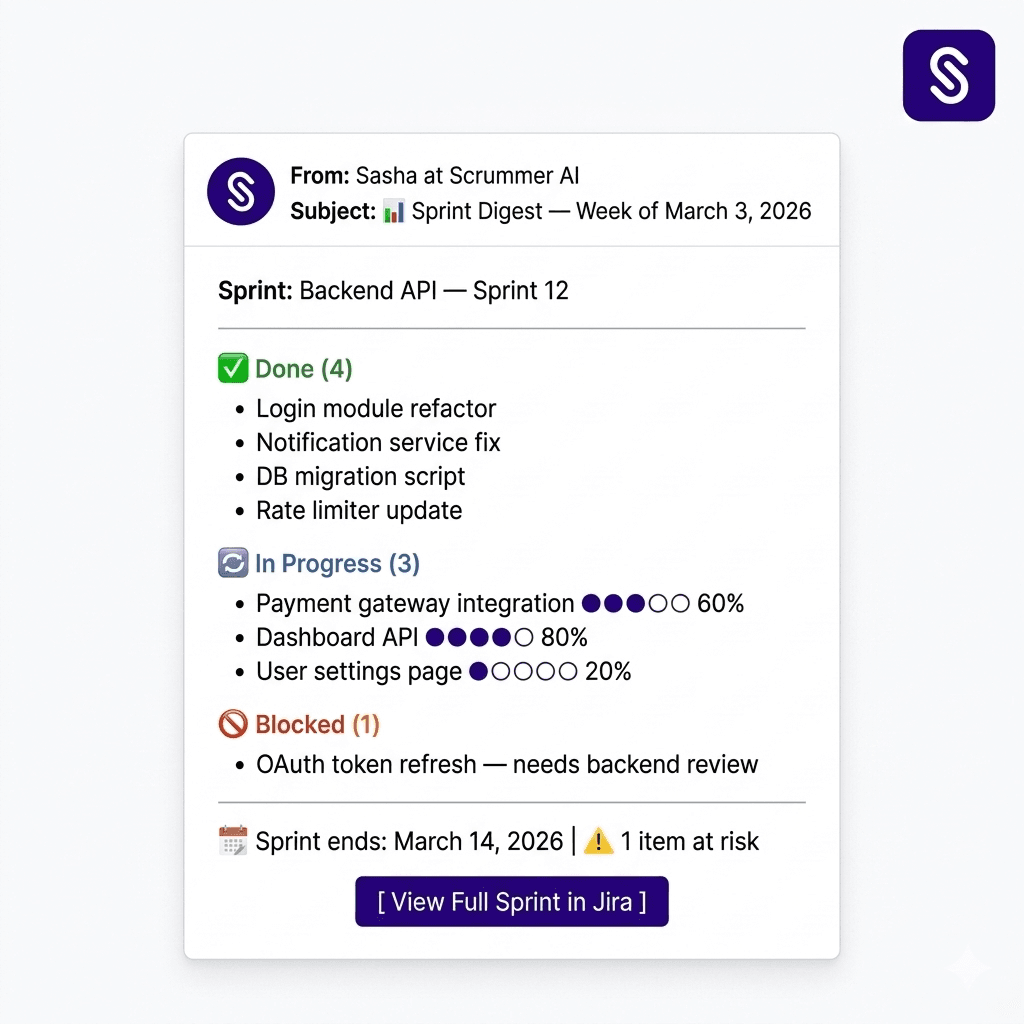
Scrummer's automated sprint digest keeps every agile project manager and stakeholder aligned — no manual status reports needed.
📋 PM INSIGHT — For an agile project manager juggling multiple squads, sprint digests mean you always have a current view of team capacity, at-risk items, and ceremony outcomes — without running extra check-in meetings.
Natural Language Querying: Your Sprint Intelligence Layer
One of the most underrated capabilities of a modern AI scrum assistant is the ability to query your team's work history in plain English.
Instead of digging through Slack archives or filtering Jira boards, you can ask Sasha directly:
- "What's blocked across the team right now?" - "Summarize the last 3 standups" - "What did the team work on this week?" - "Who is at capacity going into sprint planning?"
This transforms the agile project manager from a passive aggregator of information into an active decision-maker. The intelligence is always there — you just have to ask for it.
Try natural queries like "What's blocked?" →
🧠 Think of it as having a scrum master who attended every meeting, read every Slack thread, and has perfect recall — available 24/7 in your team's existing workspace.
Getting Started: What to Automate First
Before you start: Scrummer's onboarding takes under 2 minutes. It infers your company and team info automatically, and Slack/Jira integrations are optional — you can skip them and still land in a working dashboard. You don't need to block off an afternoon to get value from day one.
If you're an agile project manager looking to introduce AI automation into your workflow, don't try to do everything at once. Here's a phased approach:
Week 1–2: Start with Daily Check-Ins
Connect Scrummer to your Slack workspace and configure daily check-in prompts for your team. Let the async rhythm develop before adding more automation layers.
Try Scrummer's daily standup automation →
Week 3–4: Automate Post-Meeting Summaries
Enable Sasha to join your sprint reviews and retros. Review the auto-generated summaries and compare them against your manual notes. You'll likely find the AI captures more than you expected.
Month 2: Activate Jira Automation
Connect your Jira workspace and start managing tickets via chat. Encourage your team to update statuses conversationally. Watch the board stay current without anyone being asked "can you update Jira?"
Month 2–3: Set Up Sprint Digests
Configure weekly sprint digests for your key stakeholders. Redirect the time you were spending on manual status reports toward actual sprint work.
The Agile Project Manager's New Role
Here's what's worth saying clearly: AI automation doesn't replace the agile project manager. It elevates the role.
When the administrative overhead of standups, Jira updates, and status reports is handled by an AI scrum assistant, the agile PM is freed to focus on what actually creates value — removing systemic blockers, coaching team dynamics, sharpening sprint strategy, and communicating outcomes to stakeholders.
Engineering leads at companies like OpsAway, PlugScale, and Opolis are already doing exactly this — using Scrummer to cut ceremony overhead and reclaim strategic bandwidth.
The teams winning in 2026 aren't the ones with the most meetings. They're the ones where execution context flows automatically, blockers surface before they become emergencies, and the PM has time to think strategically instead of chasing updates.
🚀 "Scale your team without the meeting bloat" — that's Scrummer's promise to agile leads. Spot sprint risks before they blow up your Friday release. Stop hunting through Slack threads for meeting outcomes. See who's at capacity before sprint planning even starts.
Ready to Reclaim Your Sprints?
The daily standup isn't broken. The manual overhead around it is.
By pairing your agile process with an AI standup meeting tool like Scrummer, you can preserve the collaboration and transparency that makes Scrum work — while eliminating the repetitive, expensive busywork that slows teams down. Automated daily standups, intelligent blocker detection, Jira automation, and sprint digests aren't future features. They're available today.
The question is: how many more $80,000/year standups can your team afford?
Book a demo with Scrummer and see how agile workflow automation looks in your team's existing Slack or Teams setup — in under 30 minutes.
Want to go deeper? Explore how Scrummer.ai handles retrospective automation, Jira integrations, and async standup tools for distributed teams.
Frequently Asked Questions
Q: What does an agile project manager actually do in a daily standup?
An agile project manager facilitates the standup, tracks blockers, and ensures action items get followed up. With an AI standup tool like Scrummer, the facilitation and follow-up happen automatically — freeing the PM to focus on systemic blockers and sprint strategy instead of running the meeting.
Q: How do you automate a daily standup meeting?
Connect an AI standup tool like Scrummer to your Slack or Teams workspace. The agent prompts each team member individually at a configured time, collects responses, detects blockers, and delivers a structured summary — no synchronous meeting required.
Q: What is the best AI tool for agile project managers in 2026?
Scrummer.ai is built specifically for agile teams — it automates daily standups, detects blockers from meeting transcripts, manages Jira tickets via chat, and sends sprint digests to stakeholders. It connects with Slack, Teams, Google Meet, Jira, and both Google and Outlook calendars.
Q: How does AI help agile project managers with sprint planning?
AI tools surface sprint health data — ticket progress, blockers, team capacity — through natural language queries in Slack. Instead of manually pulling Jira reports, an agile project manager can ask Sasha "Who is at capacity going into sprint planning?" and get an instant answer.
Q: Can async AI standups replace synchronous scrum meetings?
For status updates, yes — research shows 47% of standups can be async without losing alignment, and teams report 15–20% more deep work time after switching. Synchronous meetings are still valuable for decisions, retrospectives, and complex problem-solving.
Q: How long does it take to set up Scrummer for an agile team?
Under 2 minutes. Scrummer.ai infers your company and team context automatically after login. Slack and Jira integrations are optional and can be connected or skipped during onboarding.
Also Read
- The 30-Minute Standup is Dead (And Why AI Should Run It) — Stop wasting time in zombie standups. Learn how an AI agent in Slack and Teams handles status updates without adding another tool. - What Is an AI Scrum Master? The Complete 2026 Guide — How AI Scrum Masters work, why modern agile teams need them, and how Scrummer transforms sprint predictability. - How High-Performing Teams Automate Jira Tickets from Meetings — Most teams don't fail because they don't talk enough. They fail because what they agree on never makes it into execution. - The Black Hole of Slack: Why Your Decisions Disappear — Losing ~30% of team context because decisions in Slack never make it to Jira? Here's how to fix it.