
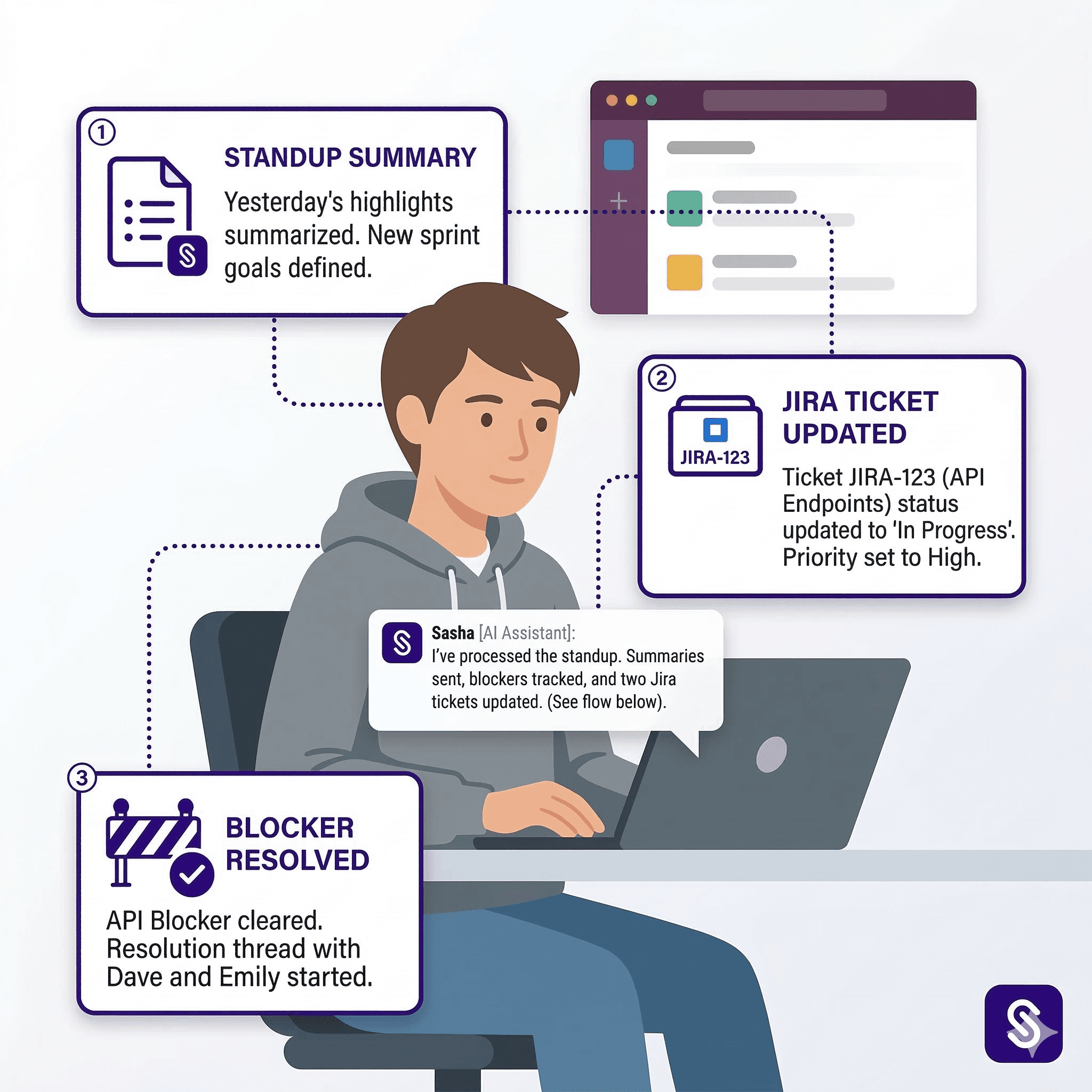
📌 TLDR
- Agile PMs spend a disproportionate amount of time on coordination overhead — standups, status updates, and chasing Jira tickets — rather than actual project management. - AI assistants are now handling meeting summaries, blocker detection, daily check-ins, and Jira updates automatically. - As per the AI4Agile Practitioners Report 2026 by Scrum.org, 83% of Agile practitioners already use some form of AI — but most only scratch the surface. - Teams using AI meeting assistants report a 25% reduction in meeting time and a 30% improvement in action item completion rates (Glean, 2025). - Tools like Scrummer AI are purpose-built for Agile teams — connecting Slack, Jira, Google Meet, and Teams in one place.
There's a version of Agile that looks great on a whiteboard. Focused standups. Clear blockers. Crisp sprint goals. Action items that actually get done.
Then there's the version most Agile Project Managers actually live — where the standup bleeds into a 30-minute status meeting, blockers get buried in Slack threads, and you're spending more time being a human router than leading your team forward.
If that sounds familiar, you're not alone. And increasingly, Agile PMs are finding the answer isn't a new framework. It's an AI assistant.
The Coordination Tax Is Real
Ask any experienced Agile Project Manager where their time actually goes, and the answer is rarely "building roadmaps" or "coaching the team." It's status updates. Meeting follow-ups. Asking someone to update Jira. Scrolling back through a Slack thread to find a decision made three days ago.
According to a widely-cited thread on Reddit's r/projectmanagement community, the biggest daily time drains for PMs include writing project updates, summarizing meetings and retros, and answering the constant "where is that doc?" question — tasks that are repetitive, low-value, and increasingly automatable.
Scrum.org's own forums document the same pattern from the practitioner side: standups routinely exceed their timebox, blockers get surfaced in the meeting but resolved hours later in side-conversations, and the whole cycle repeats the next day.
💬 "Standups have consistently turned into status updates across nine different companies I've worked at." — Developer in Reddit's r/ExperiencedDevs (Sep 2025)
This isn't a people problem. It's a tooling gap. Agile ceremonies were designed for coordination — but without automation, the coordination itself becomes the overhead. As we explored in The 30-Minute Standup is Dead (And Why AI Should Run It), this pattern is now endemic across engineering teams of every size.
AI Adoption in Agile Is Already Happening — Just Unevenly
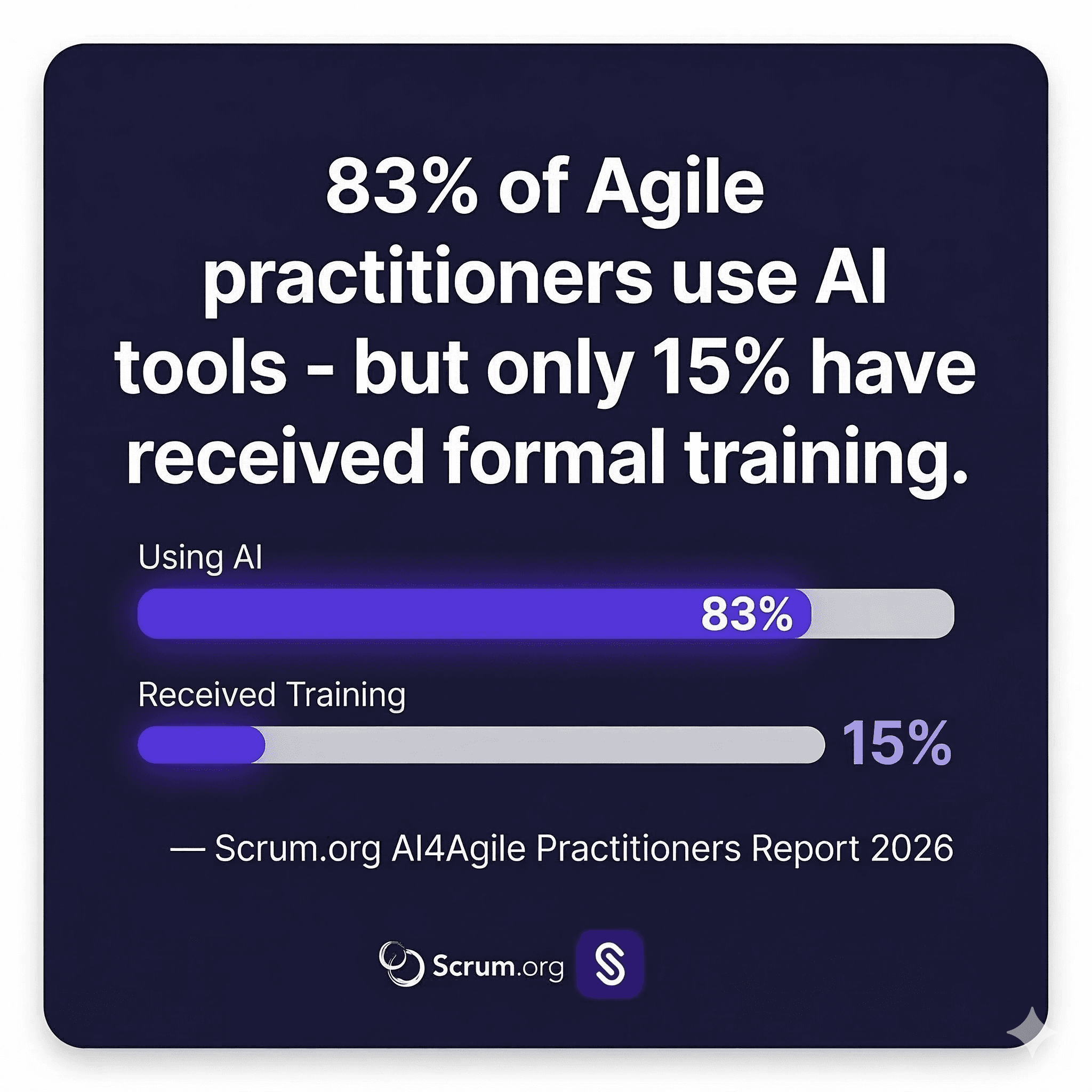
Here's something that might surprise you: 83% of Agile practitioners already use some form of AI tool, according to Scrum.org's AI4Agile Practitioners Report 2026. So the question isn't whether AI is entering Agile workflows — it's already there.
The real gap is depth. The same report found that only 15% of practitioners have received formal training on AI tools, and the majority still use AI for surface-level tasks like drafting emails or summarizing documents — not for the kind of workflow automation that actually removes the coordination tax.
⚡ 83% of Agile practitioners use AI tools, but only 15% have received training on how to use them effectively — Scrum.org AI4Agile Practitioners Report 2026
This is the gap purpose-built AI scrum assistants are designed to close. Not by replacing the Agile PM — but by automating the parts of the role that were never worth their time in the first place. For a deeper look at what this role is becoming, see our guide on What Is an AI Scrum Master? The Complete 2026 Guide.
What Agile PMs Actually Want From AI
The skepticism around AI project manager tools is real and well-documented. In a 2025 Reddit thread in r/projectmanagers, one PM put it plainly:
💬 "AI could be beneficial, but only if it comprehensively grasps the entire workflow rather than functioning as a disjointed assistant that requires constant oversight."
That's the exact frustration with generic AI tools dropped into engineering workflows. They don't understand sprints. They don't know what a blocker is. They've never heard of a retro.
What Agile PMs consistently ask for, across forums and research, is simple:
- Seamless integration with the tools already in use (Jira, Slack, Teams, Calendar) - No manual context re-entry — the AI should understand what happened in the meeting without you summarizing it - Actionable outputs — not just summaries, but tickets created, owners assigned, threads started
This is why the shift is happening toward tools that are natively built for Agile environments, rather than generic AI assistants retrofitted for project management.
The Numbers Behind the Switch
The productivity case for AI meeting assistants in Agile teams is now backed by concrete data:
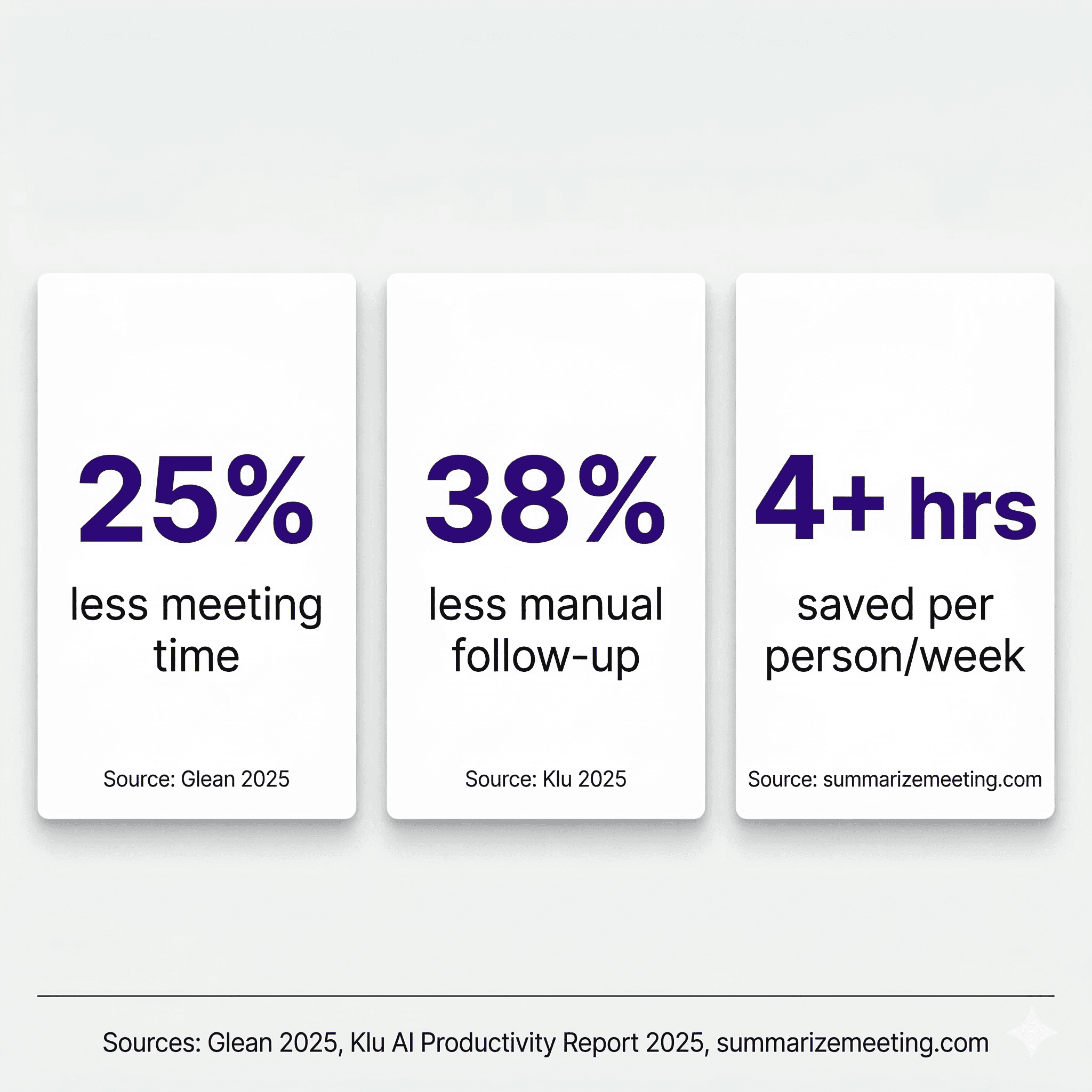
- Teams using AI meeting assistants report a 25% reduction in meeting time, a 30% improvement in action item completion rates, and a 20% increase in overall team productivity — as reported by Glean's 2025 analysis of enterprise AI tool usage - An analysis of over 10,000 meetings by Klu's AI Productivity Report 2025 found AI automation reduces manual follow-up time by 38% and increases decision-making speed by 33% - 62% of users report saving at least 4 hours every week with AI meeting tools — equivalent to over one full month of work recovered per year, per person (summarizemeeting.com, citing Otter.ai data)
For a scrum team of 10, even a conservative 5-hours-per-week saving per person at standard engineering rates translates to over $130,000 in recovered productivity annually.
⚡ A 10-person engineering team saving 5 hrs/week with AI tools = $130,000+ in recovered productivity annually (Source: summarizemeeting.com)
Where AI Scrum Assistants Are Making the Biggest Difference
Based on what Agile teams report across Scrum.org forums, Reddit communities, and practitioner surveys, the highest-impact areas for AI team coordination tools are:
1. Blocker detection and resolution
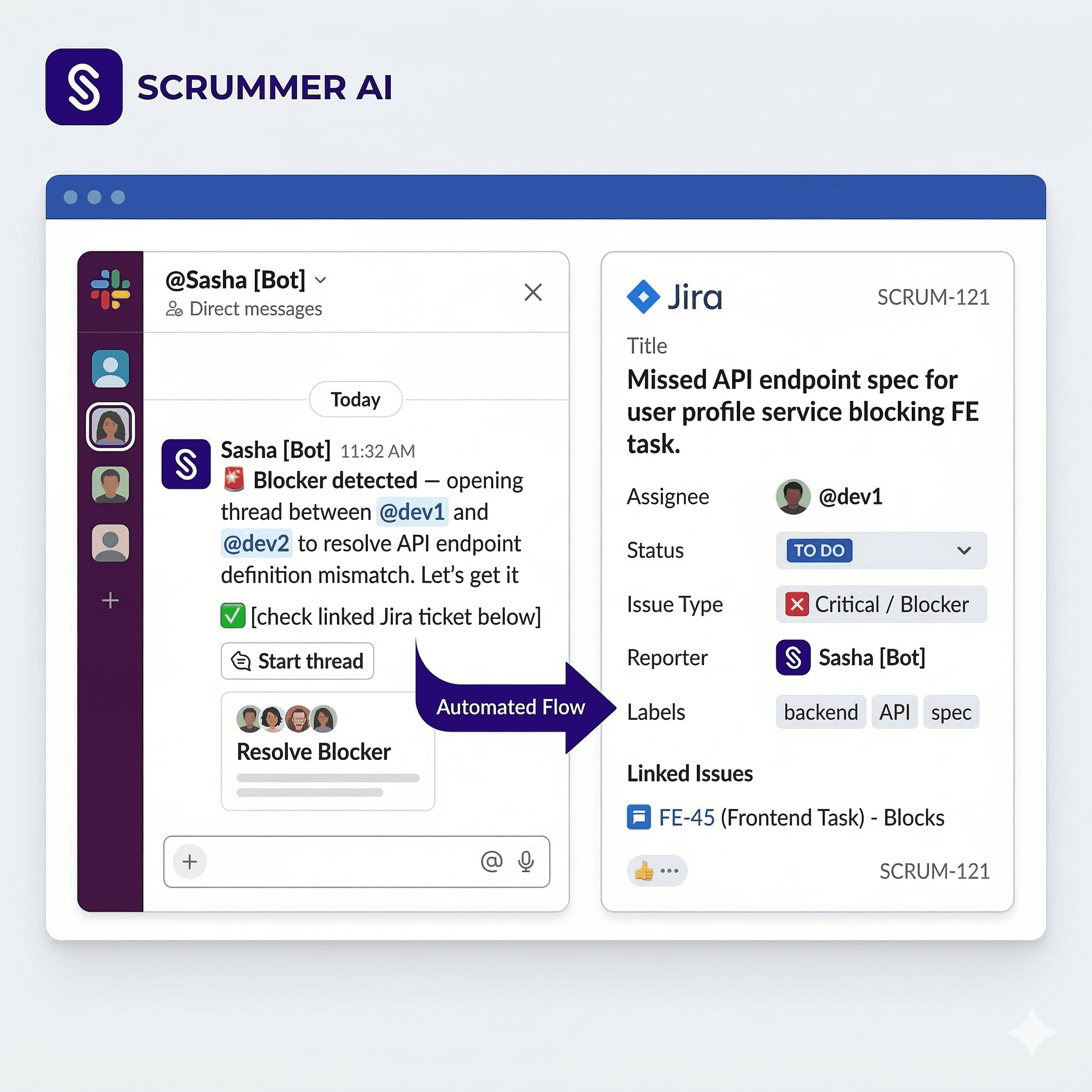
The most common standup failure mode isn't that blockers aren't mentioned — it's that they're mentioned and then nothing happens for hours. When a blocker is reported, Scrummer's Sasha automatically creates a direct message thread between the relevant participants so resolution begins immediately — no manual routing by the PM required. This is the exact execution gap we break down in How High-Performing Teams Automate Jira Tickets from Meetings.
2. Automatic meeting summaries and post-meeting actions
After every standup, retro, or sprint review, Sasha generates a structured summary — delivered via email and directly into your Slack channel — so no one needs to write notes, and nothing gets lost. Jira tickets can be created, updated, assigned, and commented on directly from the meeting conversation without anyone switching tabs.
3. Async daily check-ins
For distributed or remote-first Agile teams, async standups are increasingly replacing synchronous ones. Sasha prompts team members for completed, in-progress, and blocked tasks — customized by timezone and follow-up window — giving the Agile PM a full picture of team status without scheduling a single meeting.
This is especially relevant as 81% of Agile organizations now run Scrum or a Scrum hybrid, many of them across multiple time zones.
4. Sprint and retro digests
Retrospective insights and sprint progress data that used to live in spreadsheets no one reads can now be automatically compiled and delivered. Scrummer sends configurable Kanban and Sprint digest emails for selected Jira projects and boards — daily, weekly, or on a custom cadence. This supports the shift from reactive to proactive sprint management — something the Scrum.org AI4Agile Report 2026 identifies as the next frontier for AI in Agile.
The "Human Router" Problem — and Why AI Solves It
There's a phrase that keeps coming up in conversations about modern Agile PM roles: the human router. The person manually relaying standup outcomes to Jira. Pinging one developer about another's blocker. Scrolling back to find who was assigned what.
As Scrummer AI's founder shared on LinkedIn in February 2026, teams lose approximately 30% of execution context between standup and sprint completion because decisions made in meetings never make it into the systems where work actually happens. We explored this phenomenon in detail in The Black Hole of Slack: Why Your Decisions Disappear.
AI scrum assistants eliminate this entirely. When your meeting assistant joins the call, captures the context, posts the summary to Slack, creates the Jira ticket, and flags the unresolved blocker — the Agile PM is freed to do what actually requires human judgment: prioritization, coaching, stakeholder communication, and strategic planning.
💬 "We've seen teams lose ~30% of execution context between standup and sprint completion." — Scrummer AI Founder, LinkedIn (Feb 2026)
What to Look for in an AI Assistant for Agile Teams
Not all AI project manager tools are built for Agile workflows. Here's what actually matters:
|Feature|Why It Matters for Agile PMs| |---|---| |Native Jira integration|Create, update, assign, and comment on tickets from meetings without manual re-entry| |Slack & Teams presence|AI lives where the team already communicates| |Meeting summaries routed to type-specific channels|Standup summaries go to standup channels; retro summaries to retro channels — keeping context organized| |Blocker auto-detection|Surfaces risks and triggers resolution threads before they delay sprints| |Async check-in support|Enables distributed teams without adding more meetings| |Calendar sync|Joins the right meetings automatically, including recurring ones|
Scrummer AI is purpose-built around exactly this stack — integrating Google Calendar, Microsoft Outlook, Slack, Teams, and Jira in a single workflow. Setup takes under two minutes, and its AI agent Sasha works across both live meetings and async Slack and Teams channels. Explore Scrummer's pricing plans to see the option that fits your team size.
The Shift Is Already Underway
The Agile Project Manager role isn't going away — but its definition is changing. The best Agile PMs in 2026 aren't the ones who can run the tightest standup. They're the ones who've automated everything that doesn't require them so they can go deeper on everything that does.
The coordination overhead that once consumed 20–30% of an engineering manager's week — as documented on ScrummerAI.com — is now automatable. The data says so. The forums say so. The practitioners making the switch say so.
If your standups are running long, your blockers are going stale, and your Jira board only reflects reality on Fridays, an AI scrum assistant isn't a luxury — it's the missing layer in your Agile stack.
Frequently Asked Questions
Q1. What does an AI assistant actually do in an Agile team's daily workflow?
An AI scrum assistant like Scrummer's Sasha joins your scheduled meetings, captures context across all attendees, and automatically delivers structured summaries to your email and Slack or Teams channels after every standup, retro, or sprint review. Beyond meetings, it handles async daily check-ins, creates and updates Jira tickets from conversation, and opens direct resolution threads when a blocker is reported — removing the need for a human to manually route any of this.
Q2. Will an AI assistant work with the tools my team already uses?
Yes — the best AI scrum assistants are built around the tools Agile teams already live in. Scrummer AI integrates natively with Google Calendar, Microsoft Outlook, Slack, Microsoft Teams, and Jira. There's no new tool for your team to learn or a separate dashboard to check — everything surfaces inside your existing workflow.
Q3. Is AI in Agile just a trend, or is it actually being adopted?
It's well past trend territory. According to Scrum.org's AI4Agile Practitioners Report 2026, 83% of Agile practitioners already use some form of AI tool in their work. The bigger challenge now isn't adoption — it's depth. Most teams use AI for surface-level tasks and haven't yet automated the coordination workflows where the real time savings are.
Q4. How much time can an Agile PM realistically save with an AI assistant?
The data points are consistent across multiple studies. Glean's 2025 enterprise research found a 25% reduction in meeting time and a 30% improvement in action item completion rates. Klu's analysis of 10,000+ meetings found a 38% drop in manual follow-up time. For individual contributors, summarizemeeting.com reports that 62% of users save 4+ hours every week — which for a 10-person team adds up to over $130,000 in recovered productivity annually.
Q5. Does using an AI assistant mean changing how we run our Agile ceremonies?
No — and this is an important distinction. A good AI scrum assistant adapts to your ceremonies, not the other way around. Scrummer identifies your meeting type (standup, retro, brainstorming, planning) and adjusts what it captures and where it delivers output accordingly. Your team keeps running Agile exactly as it does today — the AI simply ensures nothing falls through the cracks afterward.
Q6. What happens when a team member reports a blocker — does the AI just log it?
It goes further than logging. When Sasha detects a blocker during a daily check-in or meeting, it automatically creates a direct message thread between the relevant participants so the conversation and resolution begin immediately — without the Agile PM having to manually identify, relay, or follow up on it. As Scrummer's founder noted on LinkedIn in February 2026, blockers that used to sit unresolved for ~30 hours are now addressed in under 15 minutes.
Q7. Is Scrummer AI suitable for small teams or only large engineering orgs?
Scrummer is built for Agile teams at any scale. Whether you're a 5-person startup sprint team or a larger engineering org running multiple Jira boards, the core workflow — meeting summaries, check-ins, Jira automation, and digest reports — applies equally. You can explore plans for your team size on Scrummer's pricing page.
👉 See how Scrummer AI handles team coordination, blocker detection, and Jira automation — try it free here.
Already using an AI assistant in your Agile workflow?
We'd love to know what's working (and what isn't)
Also Read
- The 30-Minute Standup is Dead (And Why AI Should Run It) — Stop wasting time in zombie standups. Learn how an AI agent in Slack and Teams handles status updates without adding another tool. - The Black Hole of Slack: Why Your Decisions Disappear — Losing ~30% of team context because decisions in Slack never make it to Jira? Here's how to fix it. - How High-Performing Teams Automate Jira Tickets from Meetings — Most teams don't fail because they don't talk enough. They fail because what they agree on never makes it into execution. - What Is an AI Scrum Master? The Complete 2026 Guide — How AI Scrum Masters work, why modern agile teams need them, and how Scrummer transforms sprint predictability.